Inside the 2025 PEI Operating Partners Forum New York
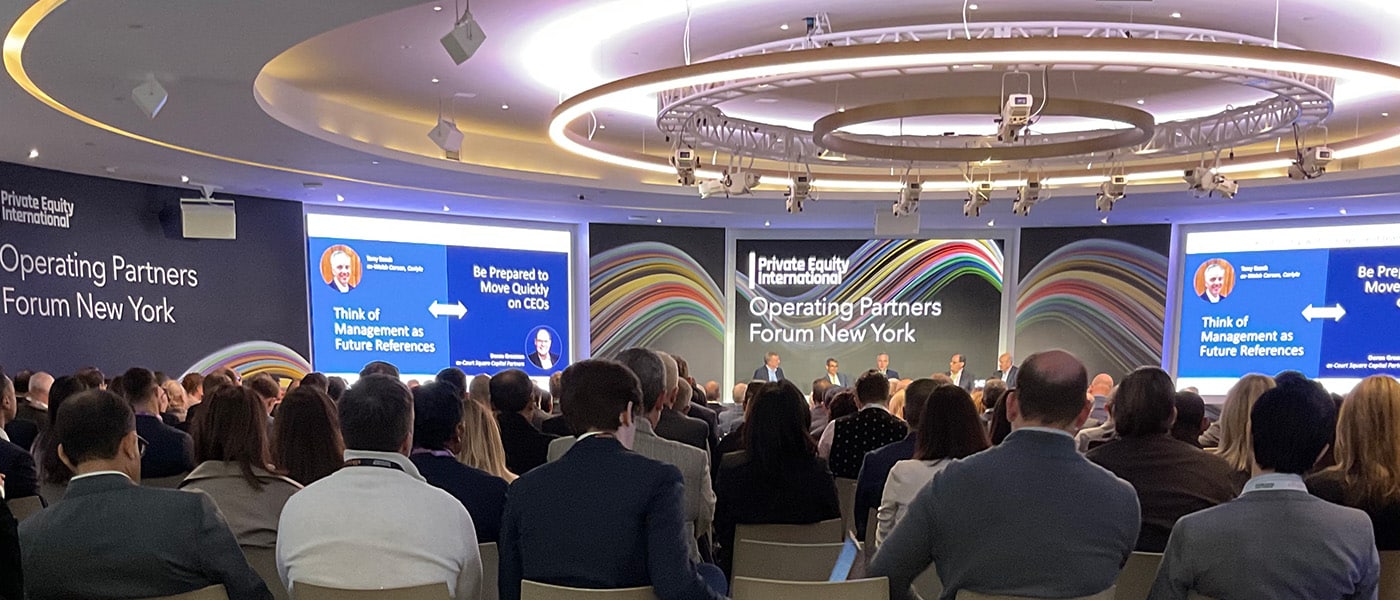


At this year’s Private Equity International Operating Partners Forum in New York, I joined hundreds of value creation leaders to discuss how the operating model continues to evolve in the current economic environment. Firms are adapting strategies to protect and enhance returns due to higher cost of capital, multiple contraction, competitive fundraising, etc., in order to accelerate EBITDA growth, which is now accounting for a much larger share of overall returns.
The panels and my personal conversations reinforced what many of us already know: the formula for desired returns has changed. Multiple expansion will only be driven by sustainable value creation, so the role of the Operating Partner has never been more crucial.
Across sessions, the messaging came through loud and clear:
Success for operating partners in today’s market depends on early alignment on value creation priorities between the sponsor and management, improved operating playbooks, an ability to measure the impact being driven, and being skilled in the human side of transformation.
1. Alignment Starts in Diligence (Engage Earlier!)
One of the strongest themes throughout the forum was the importance of engaging earlier (think: well before the close). Several operating partners stated that their “exit planning starts with buy-side diligence.” As such, operating teams shared how they are now partnering with deal teams more than ever during diligence to assess commercial levers, validate assumptions, and build trust with management before ownership even begins.
Early collaboration builds shared accountability and ensures that by Day 1, everyone is aligned on value-creation priorities, understands the playbook, and knows their role in executing it. Put simply: waiting 90 days to align on a value-creation plan risks losing momentum and stakeholder buy-in.
This approach aligns with INSIGHT’s Transaction Services, which engages with clients early in due diligence to move quickly with data engineering and market intelligence teams to identify value-creation opportunities such as price optimization, mix management and cross-selling, as well as risks including customer churn and margin degradation.
2. Value Creation Must Be Quantified (Measure What You Move)
Another consistent takeaway:
Operating Partners must measure their own impact as rigorously as they measure portfolio performance.
Several discussions focused on standing up data as quickly as possible to set the foundation of internal scorecards and metrics that link specific operational initiatives—pricing, cost improvement, go-to-market execution—to measurable EBITDA impact. As Lee Dranikoff, founder of The Ops Academy, emphasized,
“Everyone should be writing a proposal for every project, so you can define how success will be measured.”
This idea aligns closely with our work at INSIGHT. When our pricing and profitability initiatives translate directly into improved margins, the results are tracked, reported, and recognized by both the sponsor and management. For Operating Partners, identifying value creation priorities and crafting a strong strategy is only the beginning – it must be executed effectively and sustainably, with organizational buy-in and a regular review cadence to drive continuous improvement, demonstrating measurable impact, and ultimately maximizing enterprise value at exit.
The shift toward transparent, data-driven accountability signals a new level of maturity for the operating model. LPs and management teams alike are asking, “Show me the numbers.”
3. EQ is the Real Differentiator (Human Side of Value Creation)
While tools, dashboards, and AI models drew plenty of attention, the recurring theme that emotional intelligence (EQ) remains a defining skill for effective operating partners was impossible to ignore (for good reason).
The ability to influence without authority was described as “more important than IQ.” An operating partner must exhibit the ability to:
- Read the room: Understanding unspoken dynamics can be the difference between alignment and silent opposition.
- Recognize resistance: Spotting early signs of pushback allows for proactive course correction before momentum stalls.
- Guide management teams through change: Lasting transformation requires empathy, clarity, and the ability to earn trust in high-stakes environments.
Without trust, even the best playbooks fail to deliver impact.
At INSIGHT, we see this every day. Our work often involves translating technical insights into commercial action, bridging the gap between data and behavior. The firms that get this right don’t just execute on initiatives; they shift cultures.

4. Speed and Scale Depend on Readiness (AI as an Imperative)
It’s impossible to attend a 2025 forum without hearing about AI. Yet, despite the hype, a more grounded perspective emerged:
- Clarify the foundation: Success with AI isn’t about building algorithms; it’s about having clean, connected data and a clear problem to solve.
- Acknowledge the gap: Many firms admitted their data infrastructure remains fragmented, limiting the potential of AI-driven pricing, forecasting, or portfolio analytics.
- Bridge the divide: Those ahead of the curve are working with specialized partners to connect the dots between data, process, and decision-making.
In his spotlight interview, Aaron Miller, a partner in Apollo’s Private Equity Business and Head of Apollo Portfolio Performance Solutions (APPS), put it bluntly:
“If you’re not at least somewhat technology-enabled, you’ll struggle to stay relevant as an operating partner.”
The takeaway for me was that AI readiness isn’t a technology question—it’s an operational one.
Looking Ahead
What struck me most about this year’s event was the clear recognition of how critical Operating Partners have become; and not just in executing value creation initiatives, but in managing the dynamic between deal teams and portfolio company leadership. An ability to translate strategic priorities across both sides of that relationship is now essential.
Across sessions, the industry showed remarkable alignment around the fundamentals: start early, measure outcomes, and lead with empathy.
Operating partners are no longer the “fix-it” teams brought in post-close—they’re strategic stewards shaping the deal from diligence to exit. As one panelist summarized, the firms that thrive will be those that build trust early, act decisively, and demonstrate impact through data.
Those are principles we live by at INSIGHT every day.
Achieve Early Alignment with INSIGHT2PROFIT
In today’s deal environment, value creation starts well before the close. Leading firms are rethinking their operating models to prioritize early alignment, measurable EBITDA impact, and scalable capabilities from the outset. This shift isn’t just about weathering uncertainty—it’s about building conviction and momentum that last.
At INSIGHT2PROFIT, we help clients translate commercial insights into action—starting in diligence and continuing through execution. Whether you’re shaping a stronger value creation plan, validating growth assumptions, or unlocking margin opportunities, our team can help you move faster, with precision.
Contact us to learn how early alignment can accelerate outcomes and maximize value for your business.