AI Doesn’t Create Value Until It Changes How Business Gets Done


Companies are investing heavily in artificial intelligence, but many are still struggling to translate that investment into measurable financial results.
A 2026 study published by the National Bureau of Economic Research, surveying nearly 6,000 senior business executives, found that 69% of companies actively use AI, yet 89% reported no impact on productivity over the preceding three years.¹
The findings expose a critical distinction between implementing AI and realizing its potential. Deploying new technology does not automatically change how organizations operate, how employees make decisions, or how commercial opportunities get captured.
While a pricing model can identify margin opportunities, those opportunities mean little if the sales team continues discounting as they always have. AI can help prioritize customers with the greatest growth potential, but that intelligence has limited value if it never influences account planning or sales conversations. And an automated recommendation, no matter how sophisticated, cannot improve profitability if the organization fails to act on it.
For CEOs, CFOs, and commercial leaders the measure of AI success isn’t how many tools are deployed, how many agents are running, or how many hours are saved, but whether those capabilities are producing better decisions, stronger commercial execution, and measurable improvements in business performance.
Where AI Can Make the Greatest Commercial Impact
For business leaders, the most compelling AI applications are those that improve commercial decisions with the greatest influence on revenue growth and profitability.
Three areas illustrate the opportunity:
Pricing and margin improvement: AI-powered analytics can help organizations identify price opportunities at the customer, product, and transaction levels, but improving price realization requires more than surfacing recommendations. Commercial teams need to understand the rationale behind proposed changes, communicate value confidently, and execute consistently. Without the connection between intelligence and action, margin opportunities remain theoretical and realization remains low.
Customer and sales prioritization: AI can help identify attractive customer segments, uncover growth opportunities within existing accounts, and focus sales resources where they are most likely to generate profitable returns, but the benefit is only realized when those insights change territory planning, account strategies, pipeline management, and customer engagement.
Commercial performance management: AI can help leaders identify execution gaps, understand variation in seller performance, and intervene before issues become larger financial problems. Yet dashboards and alerts create little value unless managers use them to coach teams, address underperformance, and reinforce better decisions.
Across these applications, the principle is consistent: The value of AI is realized through the commercial actions it improves, not simply the information it produces.
Why Adoption Requires More Than Training
For AI-enabled recommendations to improve business performance, organizations must address how people work, how decisions are made, and how results are measured. This is where change management becomes essential.
According to Microsoft’s 2025 Work Trend Index, 82% of business leaders believe it is a pivotal time to rethink core aspects of strategy and operations.² The research reinforces that realizing AI’s potential requires more than introducing new technology. It requires rethinking how work gets done.
Organizations cannot expect employees to adopt new decision-making approaches simply because better tools are available, and successful adoption requires several connected disciplines:
Leadership alignment and accountability: Executives and functional leaders must establish clear expectations for how AI-enabled guidance will influence decisions. Adoption cannot be treated like a technology initiative owned exclusively by IT or the analytics team. Commercial leaders must take responsibility for outcomes.
Practical training and reinforcement: Sellers, for example, need to understand how to interpret recommendations, discuss pricing changes with customers, and handle objections. Managers must reinforce those behaviors through regular coaching and performance reviews.
Integration into existing workflows: AI recommendations should be available where decisions are already made, whether during account planning, customer negotiations, pricing approvals, or pipeline reviews.
Performance measurement: Leaders need to understand whether recommendations are being acted upon, how consistently teams are executing, and whether those actions are improving commercial outcomes.
Aligned incentives: Organizations must examine whether performance metrics and compensation structures support the intended behaviors. A pricing initiative focused on margin improvement, for example, will face resistance if sellers are evaluated solely on revenue or unit volume.
Each of these elements must work together. Training without accountability rarely sustains behavior change and better information without workflow integration can be ignored.
Better decision making needs to become part of the operating model, rather than just an initiative employees are asked to support.
AI Agents Can Accelerate Execution, But They Cannot Replace It
The growing use of AI agents introduces another opportunity to improve commercial performance.
Agents can automate follow-ups, surface recommended actions, identify exceptions, and help managers monitor execution. When integrated effectively, agents can reduce administrative effort and make it easier for teams to act on insights consistently.
For example, an agent supporting a pricing initiative might identify accounts that have not implemented approved price changes, notify account owners, recommend follow-up actions, and provide managers with visibility into unresolved opportunities. While this can meaningfully improve execution, automation also introduces risk when activity becomes disconnected from business objectives. An agent that generates more notifications, tasks, or recommendations without improving decisions may simply create additional noise or work.
Automating an ineffective process does not make it more effective.
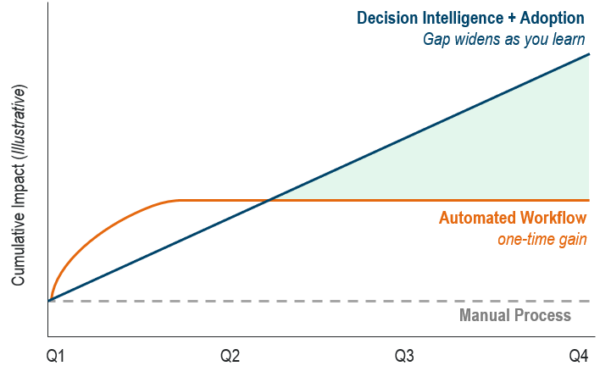
The most valuable applications connect agents to trusted intelligence, defined business rules, and clear expectations for action. Agents should reinforce the organization’s commercial strategy and change management efforts, not operate independently of them. Used appropriately, AI agents can make an established execution approach more efficient, measurable, and scalable.
Decision Quality Matters as Much as Adoption
While adoption is essential, sustainable performance improvements depend on employees trusting the recommendations they receive. Commercial decisions involve complex customer relationships, competitive dynamics, product economics, and operational constraints that AI guidance must account for to be effective.
Organizations must combine advanced analytics and AI/ML (machine learning) capabilities with industry expertise and established business rules to deliver recommendations that are consistent, accurate, and relevant. For defined commercial scenarios, deterministic guidance provides the reliability employees need, while ongoing validation ensures recommendations evolve alongside changing market conditions and business priorities.
Ultimately, when employees understand and trust the guidance they receive, they are more likely to act on it confidently and consistently.
Measuring What Matters: From Deployment to Financial Results
One of the most important questions executives should ask is whether their organizations are measuring AI success appropriately. Technology deployment and employee usage are useful indicators, but neither provides a complete picture of financial value.
A more effective measurement approach considers three distinct dimensions:
Deployment: Is the technology functioning as intended, and is trusted guidance available within relevant business processes?
Adoption: Are employees consistently using the recommendations, and are those recommendations influencing their decisions and behaviors?
Financial impact: Are those actions producing measurable improvements in outcomes such as price realization, customer profitability, win rates, sales productivity, revenue growth, or EBITDA?
These measures should be connected, not evaluated independently.
For example, an organization may report strong usage of a new pricing tool but see limited improvement in realized margins. That gap warrants investigation. Are sellers accepting recommendations but failing to execute them? Are customers responding differently than anticipated? Are the recommendations insufficiently tailored to market conditions?

Understanding where value is being lost allows leaders to address the actual execution problem rather than continuing to invest in technology without improving results. For private equity investors, this discipline is particularly important. AI initiatives should be evaluated with the same rigor applied to other value creation priorities, with clear financial objectives, accountable leadership, and demonstrable results.
The INSIGHT Approach: Connecting Intelligence to Execution
At INSIGHT2PROFIT, we believe the greatest opportunity for AI lies in combining sophisticated intelligence with the commercial expertise and organizational discipline required to turn recommendations into measurable business results.
This requires more than implementing technology.
Deep industry and functional expertise: Commercial guidance must reflect the realities of the business, including competitive dynamics, customer behavior, market conditions, and operational constraints. INSIGHT brings industry and functional knowledge to help ensure recommendations are grounded in how businesses actually compete and create value.
Precise, trusted decision guidance: INSIGHT combines advanced analytics, AI/ML-powered intelligence, and established business logic to deliver reliable, scenario-specific recommendations. Our approach emphasizes consistency, transparency, and ongoing refinement so businesses can adapt to changing conditions without sacrificing decision quality.
Change across people, process, and technology: Even the strongest guidance has limited value without execution. INSIGHT helps organizations embed recommendations into workflows, equip teams with practical training, establish accountability, and reinforce behaviors that improve commercial performance.
A full lifecycle perspective: Sustainable results require continued attention beyond implementation. From identifying opportunities and developing guidance to driving adoption, measuring outcomes, and refining execution, INSIGHT connects strategy and technology to the actions that support profitable growth.
Together, these capabilities help organizations move beyond generating insights to capturing the financial value those insights represent.
Research references
Source¹: Firm Data on AI, NBER Working Paper 34836, February 2026